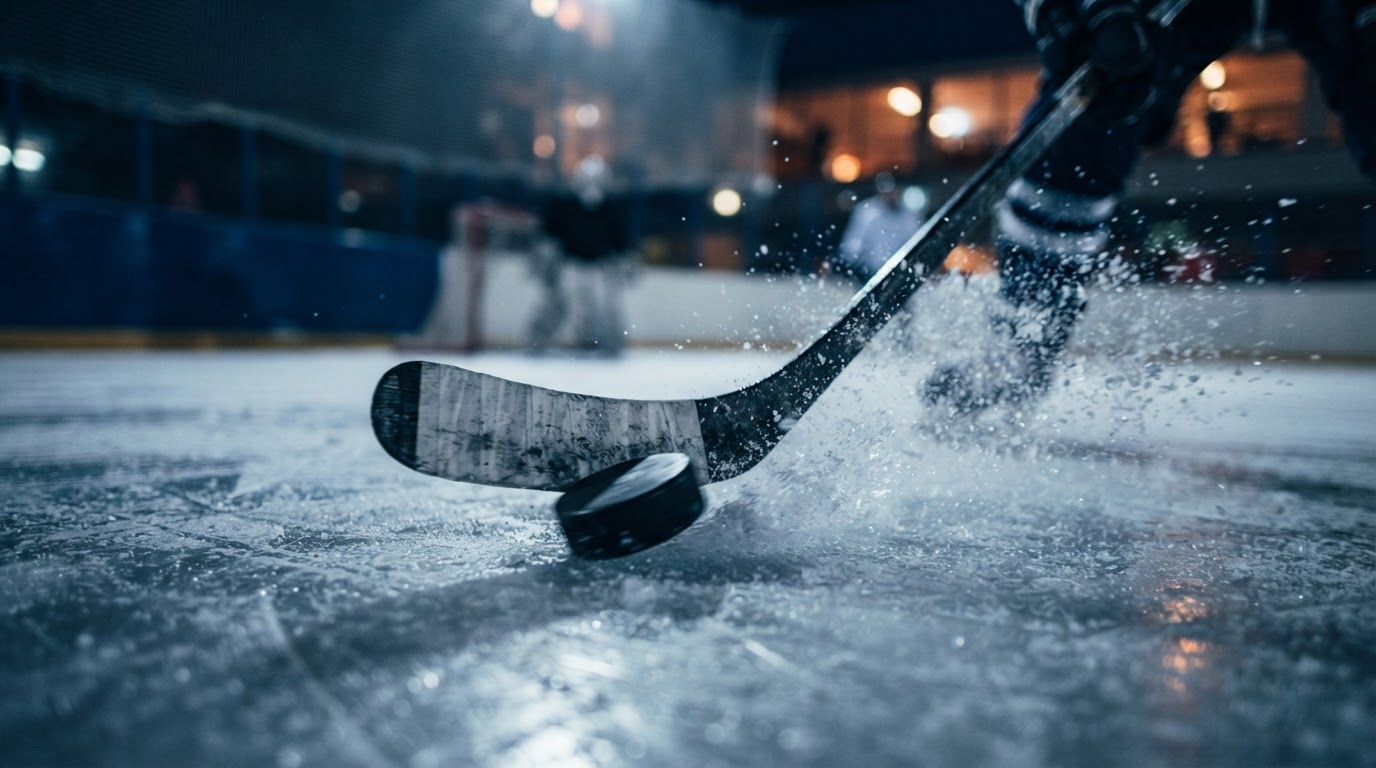
Sport guide · Winter sport
Ice Hockey
Speed, skill and physical contact on a sheet of ice. Ice hockey is among the fastest team sports in the world.
6
players per team on the ice, including the goaltender
3 × 20
three periods of 20 minutes
170 g
approximate weight of a puck (6 oz)
1875
first organised indoor game, in Montreal
How the game works
Two teams of five skaters and a goaltender use sticks to shoot a hard rubber puck into the opposing net. Players change “on the fly” without stopping play, and a typical shift lasts under a minute because the pace is so intense. If the game is tied after regulation time, it goes to overtime and, depending on the competition, a shootout.
Offside and icing
Offside: an attacking player may not cross the opponent’s blue line before the puck does. If they do, play stops for a face-off.
Icing: a team may not shoot the puck from its own half across the opponent’s goal line without anyone touching it. The face-off then returns to the offending team’s end, and that team cannot change players. The exception is a team playing short-handed, which is allowed to ice the puck.
Penalties
- Minor (2 minutes): for tripping, hooking, holding or slashing. The team plays one player short (a “power play” for the opponents).
- Major (5 minutes): for more serious infractions. In the NHL, fighting is the best-known example.
- Misconduct and match penalties: for the most serious or dangerous conduct, which can remove a player from the game.
A short history
Stick-and-ball games on ice were played in northern Europe for centuries, but modern ice hockey grew up in Canada. On 3 March 1875, the first recorded organised indoor game took place at the Victoria Skating Rink in Montreal. In 1892, Canada’s Governor General, Lord Stanley of Preston, donated a silver bowl as a prize for the country’s best amateur team. That trophy became the Stanley Cup, first awarded in 1893 and now the prize of the NHL.
The International Ice Hockey Federation (IIHF) was founded in 1908. Ice hockey made its Olympic debut at the 1920 Summer Games in Antwerp before moving to the Winter Olympics in 1924. The annual IIHF World Championship is followed passionately across Europe. Latvia, co-host in 2021 and 2023, won a historic bronze medal in 2023.
Did you know?
- Pucks are frozen before games so they bounce less and glide more predictably.
- A regulation puck is 3 inches (7.6 cm) across and 1 inch (2.5 cm) thick.
- Each NHL Stanley Cup winner gets its players’ names engraved on the trophy.
- International rinks have traditionally been wider than North American ones, which suits a more skating-based game.
Key terms
- Power play: a period when one team has more players on the ice because of an opponent’s penalty.
- Face-off: the restart, where the official drops the puck between two opposing players.
- Hat-trick: three goals by one player in a game. Fans traditionally throw hats onto the ice.
- Empty net: when a trailing team pulls its goaltender for an extra attacker late in the game.
Explore more sports

Football
Offside, cards and VAR explained, plus the story from 1863 to the World Cup.

Motorsport
Formula 1, rallying, Le Mans and MotoGP, plus every racing flag explained.
Tennis
Love, deuce and tiebreaks made simple, plus the four Grand Slams.